The Gancini Motif: A Hook That Can Actually Be Dated
The majority of fashion motifs come with a hazy origin story. Somebody’s grandmother, a saddle fitting, a ship’s rope — the details drift, no one can pin a year to them, and the house is generally pleased to leave things that way. The Gancini is unusual because it can be dated. In 1972 Women’s Wear Daily published a photograph of a Ferragamo bag with a hook-shaped metal closure, and that photograph remains the motif’s first documented appearance, verified through the brand’s own foundation. In this industry, a hook that comes with a paper trail is rare indeed. It also explains the weight the Gancini holds across Ferragamo bags today, from an $880 clutch up to a python handbag several times that price.
Why 1972 is an remarkable date
To weigh the date you need to know how young the leather goods were at that point. Salvatore Ferragamo built the house on footwear from 1927; bags only began in 1965, when Fiamma Ferragamo started designing them as accessories to the shoes, and the first press article featuring a Ferragamo bag is dated 1969. That places the hook in the trade press barely three years after bags became a story worth reporting at all. That timing matters, because it means the motif was not grafted onto an established handbag line to lend it heritage. It arrived while the category was still being invented inside the house, as a working closure on a working bag. A motif that starts as a functioning fastening tends to outlive one that begins as an ornament, and this one has.
Gancio or Gancini? Neither https://ferragamobag.com/handbags/ one is wrong
Shoppers often ask which spelling is right, and the honest answer is that both belong to the brand. Broadly, gancio denotes the single hook and gancini is the plural, so the motif or the family. Ferragamo, in practice, alternates between the two freely across its own product copy. On the same site and in the same season, current descriptions name two golden Gancio buckles on the Hug XS and an iconic Gancini closure on the Cara. Neither is a typo, and neither signals a different product line. If you are searching a resale platform, try both, because listings inherit whichever word the seller copied off the original tag.
What the hook actually does on a bag
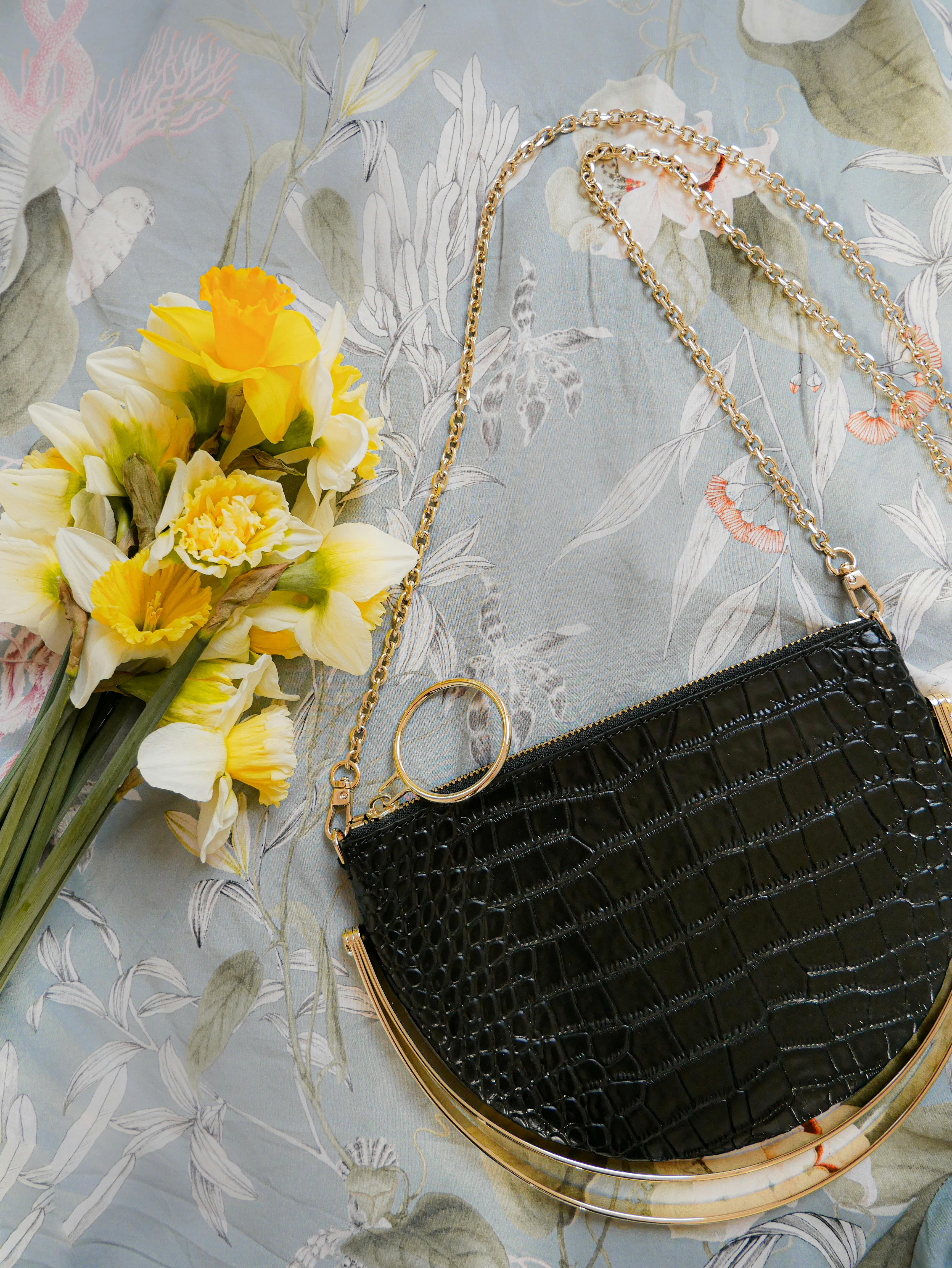
Three distinct jobs belong to the motif in the collection, and they are worth pulling apart. First it works as a clasp, a piece of cast metal that genuinely opens and closes the bag, which is how it appeared in 1972 and how it appears on the Cara today. Second it works as applied hardware, a plate, buckle or chain link that carries the visual weight without carrying the closure, as on the Hug’s wrap straps. Third it works as pattern, embossed, outlined or woven across leather, canvas and jacquard so the hook becomes a surface rather than a fitting. Those three registers allow a single motif to run from an entry-level clutch to the top of the range without repeating itself. It also explains how two Gancini bags can look nothing alike yet still feel like the same family.
Where you meet it in the current collection
The hook is the most affordable way into the house, and that is worth stating plainly. The Double Gancini group covers most first purchases, running from a clutch at $880 through mini shoulder bags at $1,250 to $1,490 and a mini bag at $1,350, up to a top handle XS at $2,500 and crossbodies at $2,400 to $2,900, with one observed as low as $830. Above those stand a Gancini chain mini at $1,850, an outline tote at $1,750 to $1,850, a wallet with chain at $890 and a folded chain clutch at $1,790. The ceiling of the family is a medium Gancini handbag in python with golden hardware, suede lining and a custom key fob at $4,100, listed at 7.2 inches high, 13.3 long and 4.7 wide, with a 21.7-inch strap and an 8.9-inch handle drop. All of these are observed 2026 market prices recorded on the brand’s own United States site on a single day, not an official price list. How the motif alters as the price climbs is traced in the table.
| Piece | Form the motif takes | Observed 2026 market price |
|---|---|---|
| Double Gancini clutch | Clasp in cast hardware | $880 |
| Gancini wallet with chain | Hardware closure with chain link | $890 |
| Double Gancini mini shoulder | Hardware clasp | $1,250 to $1,490 |
| Gancini outline tote | Outlined motif over the body | $1,750 to $1,850 |
| Double Gancini top handle XS | Load-bearing clasp | $2,500 |
| Gancini handbag, medium, python | Golden hardware with suede lining | $4,100 |
The Vara mix-up
One correction needs making here, because it circulates constantly. The Vara is a shoe, not a bag. Created in 1978 by Fiamma Ferragamo, the low-heeled pump with its grosgrain bow has sold more than a million pairs, and it belongs entirely to the footwear side of the house. It is not a handbag line and never has been, so any reference to a Vara handbag collection is simply wrong. Now and then the bow reaches leather goods as a borrowed detail, most notably on the Ginny — a Vara-plate bowling bag that appears in resale rather than in the current line-up. When you shop pre-owned it helps to keep the two apart: a listing that calls the Vara a bag was written by somebody who did not check.
Reading the hardware
Being cast metal, the hook is the part of a Ferragamo bag people inspect most closely. Most finishes are gold-tone, a minority silver-tone, and gold-tone plating is precisely that: plated rather than solid, which makes abrasive cleaners a mistake. Beyond that, it is worth being clear about what the brand does and does not publish. No public authentication guide is published by Ferragamo; its only stated guidance is to buy from its own website or from authorised stores and distributors. What follows is community consensus among pre-owned buyers rather than anything the house has confirmed, and it should be treated as soft signal only. The brand’s nearest official equivalent to an in-person check is its Repair Services, offered for a selection of authentic products at selected boutiques with proof of purchase.
- The crispness, spacing and spelling of the stamping on the interior leather tag.
- Casting quality and weight of the Gancini hardware itself.
- Evenness of the stitching along edges, gussets and straps.
- How the leather feels in the hand against known examples.
- The white dust bag and its red drawstring.
The hook in resale
Gancini pieces do differently second-hand from the house’s headline silhouette, and the gap is telling. On a major platform in September 2026, a medium Gancini turnlock flap sat at $1,130 to $1,190, a Gancini Margot hobo $1,020, a medium jacquard Gancini shoulder tote $935 to $1,045 and a small Gancini crossbody $690. In medium, a vintage Gancini flap shoulder bag sat at $560, close to the archive floor. One exception broke the pattern: a large Trifolio tote in embossed Gancini at $2,040, the top of the archive band and a style no longer in the United States line-up. So the hook holds a broad, steady band of roughly $560 to $1,200 rather than a steep summit. Brand-operated stores inside outlet villages carry Gancini pieces too, but there is no official online outlet at all, so any site presenting itself as one is not the brand.
Why a documented birthday matters
It would be easy to treat the 1972 photograph as trivia, and it is not. A dated first appearance means the motif can be traced rather than merely asserted, which is unusual enough in fashion to count for something. The hook also predates almost every current Ferragamo bag by decades, which makes a Gancini clasp on a 2026 shoulder bag honestly continuous with the archive rather than a revival of it. That continuity is the practical case for a buyer — a motif this deeply rooted is unlikely to be quietly dropped, and the pieces carrying it stay legible across seasons. Whether you are browsing a Ferragamo shop, waiting for a seasonal Ferragamo sale, or scanning listings that resale platforms still file under Salvatore Ferragamo, the hook is the through-line. More than fifty years after a photographer pointed a camera at it, it is still doing the same job.